
ADA Web Compliance: Protect Your Website from Lawsuits
by Julie | Nov 6, 2025
Most business owners don’t realize their website can create legal risk. Accessibility isn’t just a “nice-to-have” feature; it’s now a requirement under the Americans with Disabilities Act (ADA).
What That Means
If someone with a disability can’t easily use your website, for example, a screen reader can’t interpret your content or a form can’t be navigated by keyboard, it can lead to an ADA complaint or lawsuit. Businesses that focus on ADA compliance and websites are far less likely to face legal challenges.

The Standards That Apply
Websites are evaluated using the Web Content Accessibility Guidelines (WCAG 2.2 AA), created by the World Wide Web Consortium (W3C). These guidelines ensure people with visual, auditory, motor, or cognitive disabilities can access your site. Proper ADA web compliance ensures your site meets these standards.
Why “AA” Matters
“AA” is the industry-accepted benchmark for compliance; it’s the same level used by federal agencies and most legal settlements. Learn more: w3.org/TR/WCAG22
The Truth About “Accessibility Widgets”
Many companies install an accessibility “widget” or “overlay”; that small icon in the corner of a website that adjusts colors or text size; thinking it makes them compliant.
However, overlays only sit on top of your website; they do not repair the underlying code, which is what attorneys test when filing lawsuits. Even the overlay companies themselves publicly state they cannot guarantee ADA or WCAG compliance.
That is why a site can have the widget installed and still fail a compliance scan, or worse, still face a lawsuit. Relying on overlays alone is not a strategy for making your website accessible.
Why They Don’t Work
Overlays only sit on top of your website; they do not repair the underlying code, which is what attorneys test when filing ADA lawsuits.

What the Experts Say
Real Cases in the U.S.
Recent U.S. cases have confirmed this reality. A class-action lawsuit against accessiBe alleged that businesses using its accessibility widget still faced ADA claims despite assurances of compliance.
The American Bar Association also warns that widgets and overlays won’t stop ADA digital lawsuits and that websites using them are not immune to ADA claims. Using an ADA compliant website builder or following proper coding standards is a better approach.
What This Means for You
Even with a widget in place, a website can still fail a compliance scan, leaving the business exposed to potential legal action. Investing in creating accessible websites ensures your business meets legal requirements.
Why Does Complying With the ADA Website Accessibilities Matter?
Accessibility lawsuits are rising every year, and most don’t target large corporations. According to Forbes, 77% of web accessibility lawsuits are filed against businesses earning under $25 million per year.
The U.S. Department of Justice confirms that websites offering goods or services to the public are required to be accessible under the Americans with Disabilities Act (ADA).
Plaintiffs do not need to prove intent; only that a website is not accessible to people with disabilities, a principle established in multiple U.S. cases including National Federation of the Blind v. Target Corp.
Legal experts note that most ADA website cases settle for $5,000–$50,000 to avoid court costs, with many reaching settlement before trial. Conducting a website ADA audit helps prevent these costly settlements.
Website accessibility is no longer optional; it is now an established part of ADA website compliance and one of the fastest-growing areas of litigation affecting small and midsize businesses.
Our Mission
Our goal is simple...
Make your website accessible, compliant, and legally defensible, the right way.
True compliance isn’t a switch or an AI feature. It requires proper testing, smart implementation, and ongoing care, which is exactly what our team provides.

What This Report Shows You
This report provides a detailed analysis of your homepage, highlighting the specific accessibility issues that need to be corrected to meet ADA and WCAG 2.2 AA standards.
Your homepage is the foundation of your online presence; it reflects the same structure, code patterns, and design choices found throughout your website. If accessibility issues appear here, they are very likely repeated across other pages.
In other words, this is not just a snapshot; it is a clear indicator of your site’s overall accessibility health, and what must be fixed to bring your business into compliance.
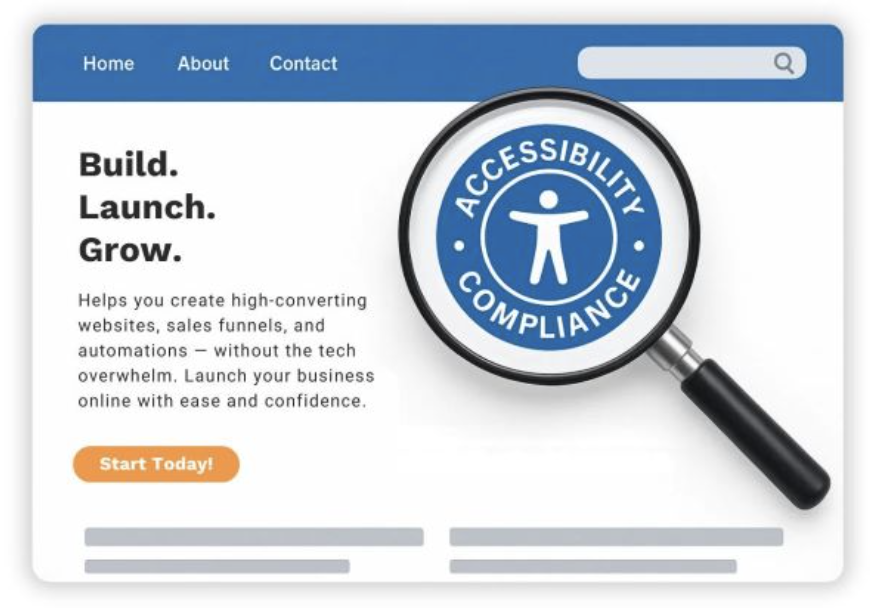
What does a complete audit provide?
- A full scan of every public-facing page
- A line-by-line code evaluation for accessibility errors and ARIA
compliance - A manual review of site structure, navigation, and user experience
- A prioritized list of corrections, clearly outlining what needs to be fixed and why
By completing the full audit, you will have a comprehensive, defensible roadmap to bring your business into ADA web compliance, ensuring your website functions correctly for every visitor and protects your company from unnecessary legal risk.
Complete, Ready-to-Use Results
Your full accessibility audit will include every detail your business needs to reach compliance; nothing will be left out or hidden behind technical jargon. The report can be handed directly to your web designer or developer for implementation, or our team will be happy to assist you in completing the remediation process.
Either way, you will have everything required for making your website accessible, achieving ADA compliance, and protecting your business legally, without needing to purchase additional tools or outside reviews.
Get Your FREE Website ADA Audit Today!
Is your website truly accessible and ADA compliant? Don’t wait for a lawsuit to find out! Our FREE Homepage Audit shows exactly where your site may be failing accessibility standards and provides clear steps to fix it.
Upgrade to a Fully ADA-Compliant Platform
For long-term accessibility, move your site to the Lime ADACompliant Platform. Built to meet ADA & WCAG 2.2 AA standards, it simplifies compliance, lowers maintenance costs.